
Standing water after rain? Start with where the water comes from—and where it can safely go.
Not sure what your drainage problem needs? Land & Site Consultation
Water pooling beside the house, a yard that stays saturated, or runoff washing gravel out of the driveway needs more than a guess at which drain to install. Baxter’s Excavation helps property owners assess the problem and scope practical grading, surface drainage and drainage pipe work.
Based in Burlington, serving Skagit, Snohomish and Pierce County, including Roy. Tell us what happens when it rains and we’ll discuss the next step.
Call (360) 899-8468Text us · Request a free field-work estimate
Licensed & Insured · WA Contractor Reg. BAXTEET811JA
Drainage problems we can help assess
- Standing water: puddles that linger in low spots after rain.
- Water moving toward foundations: surface runoff flowing toward the house instead of away from it.
- Saturated yards: soft, muddy ground that limits access or makes the yard hard to use.
- Driveway washouts and runoff: water cutting channels, carrying away gravel or collecting along the drive.
- Drainage after clearing or site work: changed grades or water paths that need a closer look.
If water is near electrical equipment, the ground is unstable, or a washout makes access unsafe, stay clear. Take photos only from safe, stable ground.
Want to read more first? See our guide: Yard Drainage for Standing Water in Skagit, Snohomish & Pierce County.
The right approach depends on the site
We start with the water’s source, the slope of the ground, soil conditions, equipment access and a suitable, permitted outlet or infiltration approach. A pipe is not a complete solution if there is nowhere appropriate for the water to go.
- French drains: where intercepting shallow subsurface water fits the soil, elevations and discharge plan.
- Surface drainage and swales: shaping a route for runoff before it collects where you do not want it.
- Grading corrections: addressing low spots or slopes that direct water toward structures or across access areas.
- Drainage pipe work: installation or repair as part of an assessed drainage layout.
The scope should account for downstream effects—not simply send the problem onto a neighbor’s land or the road. Utility locations, local drainage and permit requirements, and any wetland, ditch or right-of-way constraints need checking before digging. Where engineering or other specialist input is needed, that should be identified before the work is agreed.
In Snohomish County, drainage work that changes an existing drainage course can require a Land Disturbing Activity (LDA) permit. See the county’s LDA page.
Typical drainage costs
Typical ranges. Every site is different, so we give a free estimate for yours.
- Basic French drain (50–100 ft): $1,500–$5,000
- Catch basin system: $2,000–$6,000
- Comprehensive drainage system (French drains, catch basins, downspout connections, grading): $5,000–$20,000
- Retaining wall drainage: $1,000–$5,000
Access, soil, depth, outlet location, materials, haul-off and any permits move a job within—or outside—these bands. Call or text (360) 899-8468Text us with photos of where the water sits after rain, and we’ll price your site.
Drainage services we install
We match the fix to the water problem—not the other way around. Below is what we commonly build after a site look.
French drains
A perforated pipe in a gravel trench that intercepts shallow groundwater or seepage and carries it to a safe outlet. Useful when the yard stays soft after rain and surface grading alone won’t dry it out. Length, depth and where the water can legally discharge drive the scope.
Catch basins & surface drains
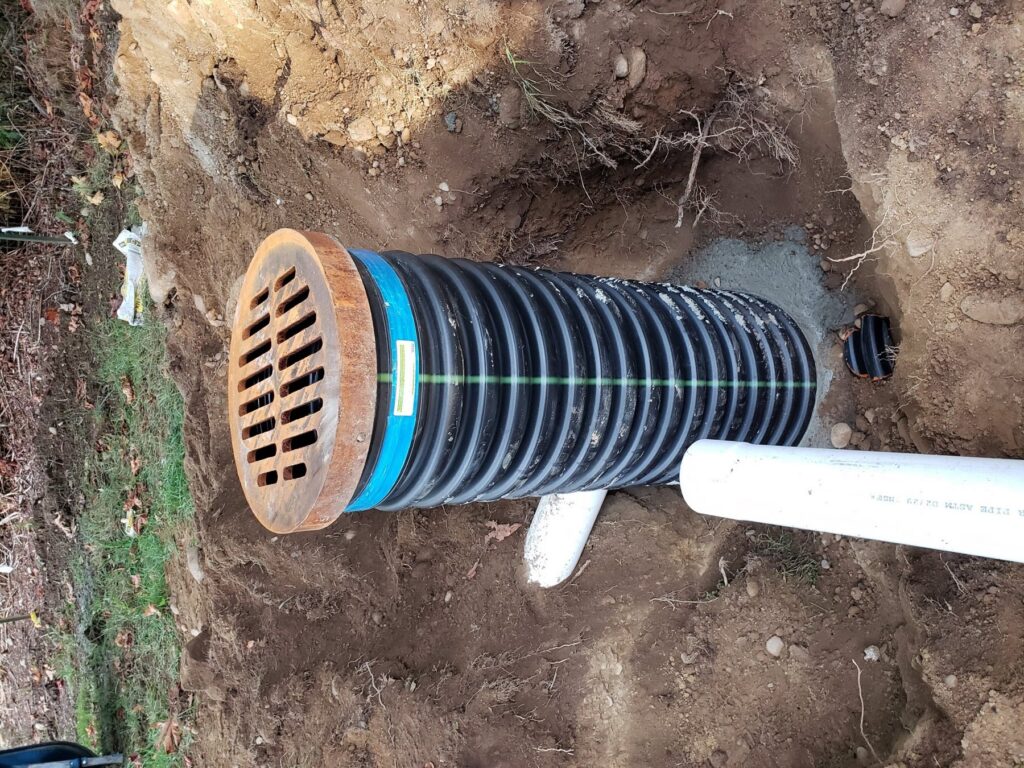
Grated basins and surface inlets that grab runoff at low spots, driveways and patio edges before it sheets toward the house. We tie them into solid pipe and route the water to an approved discharge or infiltration point.
Swales & grading
Reshaping the ground so water moves away from foundations, shops and access roads. A shallow swale or a grade correction often fixes “wet after every rain” problems without burying pipe—when slope and a place for the water to go already exist.
Retaining wall drainage
Drain rock, filter fabric and perforated pipe behind or at the base of a wall so trapped water doesn’t load the wall or seep through the face. We plan the outlet so you’re not pushing the problem onto the next property.
Downspout drainage
Getting roof water away from the foundation. We extend, bury or reconnect downspouts into solid pipe that carries the flow to a splash area, dry well or storm system—so eaves aren’t dumping next to the crawlspace.
Dry wells & infiltration
Where soils accept water and local rules allow it, a dry well or infiltration trench can take runoff on-site instead of piping it to the ditch. We check soil and setbacks first; not every lot is a good candidate.
Not sure which of these you need? Start with a free field-work estimate, or book a Land & Site Consultation if you want a paid plan before anyone digs. Call (360) 899-8468Text us.
Tell us what happens when it rains
- Describe the problem. Include your town, where water starts, where it collects and how long it stays after rainfall.
- Share safe photos. Text a wide view and a closer view, plus any visible water path. Do not enter floodwater, open a utility structure or approach power lines to get a picture.
- Agree on the scope. We’ll discuss access, whether a site visit is needed, the proposed work and an estimate before you authorize field work.
Estimates for defined Baxter field work are free. If you want broader property planning or advice before deciding what to build, our optional paid Land & Site Consultation is a separate service. Any paid consultation must be agreed to first; requesting a work estimate does not book one.
Yard drainage is not sanitary side sewer
This page covers rainwater, surface runoff and wet-ground problems. A sanitary side sewer carries wastewater from a building to the public sewer. These are different systems: yard runoff should not be routed into a sanitary sewer.
For wastewater line installation or repair, see our side sewer and storm drain services. Planning a larger property project? See land clearing and discuss drainage before changing the site’s water paths.
Drainage questions
How much does drainage work cost?
Cost depends on the cause, length and depth of the work, soil, access, materials, disposal and the discharge approach. Permits or specialist design may also affect scope. Request a free estimate for defined Baxter field work rather than choosing a system from a price alone.
Is a French drain always the answer?
No. Surface runoff may need a swale or grading correction instead. Soil, slope and a suitable outlet matter; installing a drain without checking them may not solve the problem.
Is stormwater drainage the same as sewer work?
No. Stormwater is rain and runoff; sanitary sewer carries wastewater. Tell us whether the problem is outside after rain or involves wastewater backing up so we can discuss the appropriate service.
Is an estimate different from a paid consultation?
Yes. A free field-work estimate concerns Baxter doing a defined job. The optional paid Land & Site Consultation is for broader planning and advice. We keep those separate and agree on any consultation fee in advance.
Where do you offer drainage work?
We are based in Burlington and serve Skagit, Snohomish and Pierce County, including Roy. Share your town and project details so we can confirm access and scheduling for your location.
Will drainage work keep my property dry in every storm?
No contractor can promise that. Results depend on rainfall, soil, groundwater, maintenance and conditions beyond the property. The goal is a site-appropriate improvement with a clear scope and realistic expectations.
Let’s look at the water problem before choosing the fix
Tell us where the water collects, what it affects and where your property is located.
Text your drainage photos · Request a free field-work estimate
See all the areas we serve on our Service Areas page.
Mount Vernon homeowners: see our Yard Drainage in Mount Vernon page.