Replacing a typical 40-foot side sewer in Washington costs about $2,800 to $8,300, with an average near $5,600. Deep, long or hard-to-reach lines can cost far more. In Burlington, Anacortes and Sedro-Woolley, the property owner pays for the entire side sewer, from the house to the city main.
Those figures come from Angi’s 2026 Seattle-area data, the closest published benchmark for western Washington.
Big bills do happen. In 2026, Mount Vernon city leaders heard from homeowners facing side sewer repair bills of about $25,000.
The good news: an on-site estimate tells you which part of the line has failed, so you don’t pay to replace more than you need.
What is a side sewer?
A side sewer is the private pipe that carries wastewater from your house to the public sewer main, usually under the street. It’s also called a sewer lateral or building sewer. In Washington, side sewers are generally owned and maintained by the property owner, including the part under the street.
That’s the general position of MRSC, Washington’s municipal research center, though each city sets its own boundary. (Source: MRSC — Sewer Utilities)
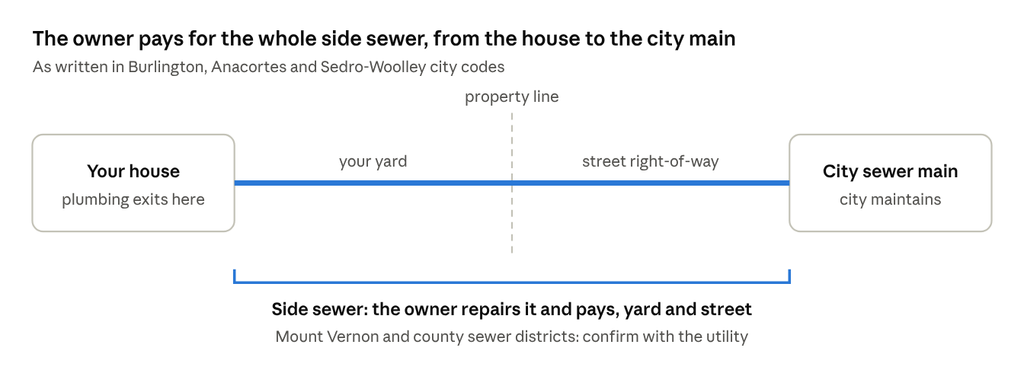
side sewer ownership · house to city main
The pipe you pay for runs the full distance, including the section under the street. Only the main belongs to the city.
How much does side sewer replacement cost in 2026?
In western Washington, side sewer work typically runs $60 to $220 per linear foot for open-trench replacement and $87 to $360 per foot for trenchless methods. For a typical 40-foot line, most homeowners pay $2,800 to $8,300. Permits add a few hundred dollars more.
| Job type | Typical cost | What it covers |
|---|---|---|
| Full replacement (open trench) | $70 – $250 per ft | Dig up and replace the whole line, house to main |
| Partial replacement / spot repair | $50 – $200 per ft | Replace only the broken or root-filled section |
| Cured-in-place pipe (CIPP) lining | $100 – $170 per ft | A resin liner inside the old pipe; little digging |
| Pipe bursting + lining | $200 – $280 per ft | New pipe pulled through and breaking the old one |
| Trenchless (all methods) | $87 – $360 per ft | Access pits only, no full trench |
| Typical 40-ft replacement, total | $2,817 – $8,327 (avg. $5,572) | Most common homeowner range |
| Permit | about $280 – $750+ | City or district permit and inspection |
What affects side sewer cost in Skagit County?
Five things drive most Skagit County side sewer quotes: how long and deep the line is, what sits on top of it, tree roots, the digging method, and what the city requires at inspection. A short, shallow line under lawn costs far less than a deep line under a driveway and street.
- Length and depth. Cost is quoted per foot, so a 60-foot line costs more than a 40-foot one. Deeper trenches need more digging, shoring and time.
- What’s on top. Lawn is cheap to restore. Concrete, asphalt or pavers must be cut and replaced. If your driveway is damaged, consider driveway repair or replacement at the same time.
- Tree roots. Roots are a common cause of cracked, blocked side sewers. A tree growing over the line may need tree removal to stop the problem coming back.
- Digging method. Open-trench excavation is usually cheapest per foot. Trenchless lining or bursting costs more per foot but avoids tearing up yards and driveways.
- City standards. Your new line must meet local code. Mount Vernon, for example, requires at least a 4-inch pipe at a 2% minimum slope for single-family homes.
Mount Vernon also requires a backwater check valve on side sewers, plus locator tape or wire buried with the pipe.
Work in the street usually means traffic control and pavement restoration, which adds cost.
Who pays for side sewer repair: homeowner or city?
In Burlington, Anacortes and Sedro-Woolley, the homeowner pays to repair or replace the side sewer, including the section under the street. The city only maintains the public sewer main. Some Washington cities split the cost at the property line, so always check your own city’s code.
| City | Who pays | Which part | Contact |
|---|---|---|---|
| Burlington | Property owner | Whole line, including public right-of-way | Burlington sewer department |
| Anacortes | Property owner | Building to the connection at the main | Public Works Operations, (360) 293-1921 |
| Sedro-Woolley | Property owner | Owner agrees to maintain the side sewer | Public Works, (360) 855-0771 |
| Mount Vernon | Confirm with the City | Ownership rules under review in 2026 | Development Services, 360-336-6214 |
Burlington
Burlington defines a side sewer as “a privately owned and maintained pipe system.” The owner’s responsibility extends to facilities in the public right-of-way.
Side sewers, “whether located in a public or private place,” must be owned and maintained by the owner of the premises.
Anacortes
The owner is “responsible for the cost of repair, installation and replacement” from the building to the sewer main.
The City may repair the street portion when the Public Works Director finds it’s in the public interest, but it isn’t required to.
If a backup is in a city main or manhole, call Public Works Operations.
Sedro-Woolley
On the City’s sewer permit, “The Owner agrees to maintain the side sewer.” A Washington-registered contractor must do any work in the public right-of-way.
Mount Vernon
In 2026, a Mount Vernon council committee discussed relief options after homeowners faced lateral repair bills near $25,000. Staff were asked to study long-term policy.
Until that’s settled, call Development Services at 360-336-6214 before work starts.
Do you need a permit to replace a side sewer?
Yes. Mount Vernon, Burlington and Sedro-Woolley require a permit and an inspection before a new or repaired side sewer is backfilled, and most require a pressure or watertight test. Washington law also requires an 811 utility locate before any digging starts.
What each city requires
- Mount Vernon: Permits are required before construction starts. Inspections must be booked at least 24 hours ahead, and all side sewers must be pressure tested.
- Burlington: Connections must be gastight, watertight and verified by testing, under the sewer department supervisor.
- Sedro-Woolley: Book inspections 24 hours ahead. Any pipe backfilled before inspection “will be uncovered.”
Before any digging: call 811
Washington’s Dig Law, RCW 19.122, requires underground utilities to be located before excavation. Give 2 to 10 business days’ notice.
A good contractor pulls the permit, books the locate and schedules inspections for you. Ask who handles each step before you sign.
Repair or replace? Open trench or trenchless?
Repair one section when the damage is in a single spot, such as one root intrusion or crack. Replace the whole line when it’s broken in several places or keeps failing. Open-trench digging is usually cheapest per foot. Trenchless methods cost more per foot but save driveways, landscaping and trees.
| Method | Cost per foot | Best when |
|---|---|---|
| Spot repair (open trench) | $50 – $200 | One break or root intrusion in an easy-to-reach spot |
| Full replacement (open trench) | $70 – $250 | The line fails in several places; mostly under lawn |
| CIPP lining (trenchless) | $100 – $170 | The pipe is cracked but still holds its shape |
| Pipe bursting + lining (trenchless) | $200 – $280 | The pipe is too damaged to line; runs under a driveway or street |
Start with a camera inspection
A sewer camera shows exactly where the line is broken, sagging or full of roots. That tells you whether a spot repair is enough.
Why open trench is often the right call
Open-trench work lets the crew see the whole pipe, fix the grade and replace it with new pipe to current code.
It’s also the natural choice when you’re already digging, for example during excavation and site work or a new driveway.
Does homeowners insurance cover side sewer replacement?
Often not. In Washington, homeowners insurance usually doesn’t cover the section of side sewer between the property line and the main. Read your policy and call your insurer before work starts, so you know what you’ll pay yourself.
MRSC notes that homeowner’s insurance “usually does not cover the portion of the side sewer between the property line and the sewer main.”
Warning signs your side sewer is failing
Watch for several slow drains at once, gurgling toilets, sewage odors, backups in your lowest drain, and soggy or extra-green patches over the sewer line. One slow sink is usually a local clog. Several symptoms together usually point to the side sewer.
- Several drains slow at the same time
- Gurgling from toilets or tubs
- Sewage smell inside or in the yard
- Water backing up into a basement drain or shower
- Soggy ground or unusually green grass along the line
- Clogs that come back soon after clearing
How to keep side sewer costs down
Fix only what’s broken, plan the work before it becomes an emergency, and bundle digging jobs. A camera inspection and an itemised quote stop you paying for more pipe than you need.
- Act early. A slow drain is cheaper to fix than a sewage backup.
- Get the line inspected first. It shows whether a spot repair will do.
- Bundle digging work. Fix drainage, driveways and side sewers in one excavation. If water also pools in your yard, ask about storm drains and French drains.
- Deal with root sources. Remove or relocate trees growing over the line with tree removal.
- Ask your city about relief. In 2026, Mount Vernon discussed narrowing a permit-fee waiver for homeowners facing large lateral bills.
Side sewer repair and replacement in Skagit County
Baxter’s Excavation repairs and replaces side sewers across Skagit County, from the first dig to the final backfill. We bring the excavators to the job, so you aren’t paying a plumber to subcontract the digging. Every job is quoted on site, so you know the cost before work starts.
We’re a licensed and insured excavation contractor based in Burlington, WA, serving Mount Vernon, Anacortes, Sedro-Woolley and all of Skagit County.
Because we also do driveways, drainage and tree removal, we can fix the whole problem in one visit:
- Side sewer and storm drain repair
- Excavation and trenching
- Driveway repair after sewer work
- Tree removal for root-damaged lines
Side sewer acting up? Call (360) 899-8468 or request a free on-site estimate.
Side sewer cost FAQs
How much does it cost to replace a side sewer in Washington?
A typical 40-foot side sewer costs about $2,800 to $8,300 to replace in western Washington, with an average near $5,600. Deep or street-crossing lines cost more.
Who is responsible for the side sewer in Washington?
Usually the property owner, including the part under the street. Burlington, Anacortes and Sedro-Woolley all place side sewer repair costs on the owner.
Does the city pay for the side sewer under the street?
In Burlington, Anacortes and Sedro-Woolley, no. Anacortes may repair the street portion when it’s in the public interest, but isn’t required to.
How much does trenchless side sewer replacement cost?
Trenchless replacement runs about $87 to $360 per linear foot in the Seattle area. Pipe bursting with lining runs about $200 to $280 per foot.
Is side sewer replacement covered by homeowners insurance?
Often not. Insurance usually doesn’t cover the section between the property line and the sewer main. Check your policy before work starts.
Do I need a permit to repair my side sewer?
Yes. Mount Vernon, Burlington and Sedro-Woolley require a permit and inspection. Washington law also requires an 811 utility locate before digging.
Can tree roots damage a side sewer?
Yes. Roots are a common cause of cracked and blocked side sewers. Removing the tree may stop the problem returning after repair.