Usually no, for a single tree on your own private lot. You need approval when the tree is in a critical area such as a wetland, stream buffer, or steep slope, is a city street tree, or is part of a larger clearing or timber harvest. Rules differ between Skagit County and each city.
Use the table below to find your area. Then follow the steps in the next section.
| Area | Single tree on private lot | Approval needed when | Who to contact |
|---|---|---|---|
| Unincorporated Skagit County | No permit for personal-use cutting | Critical areas; harvest over 5,000 board feet on 2+ acres | Skagit County Planning & Development Services; WA DNR |
| Mount Vernon | No land clearing permit under 2 acres | Street and planting-strip trees; clearing 2+ acres | Parks Director (street trees); Community & Economic Development (clearing) |
| Burlington | Not regulated by the tree chapter | Street trees: planting, removal, topping, major pruning | Community Development Department |
| Anacortes | No general permit found for existing lots | Critical areas and buffers; new subdivisions | City of Anacortes planning department |
| Sedro-Woolley | No removal permit in the tree chapter | Hazard or nuisance street trees | Public Works Director |
Each row is explained, with official sources, in the city sections below.
How to check if your tree needs a permit: 6 steps
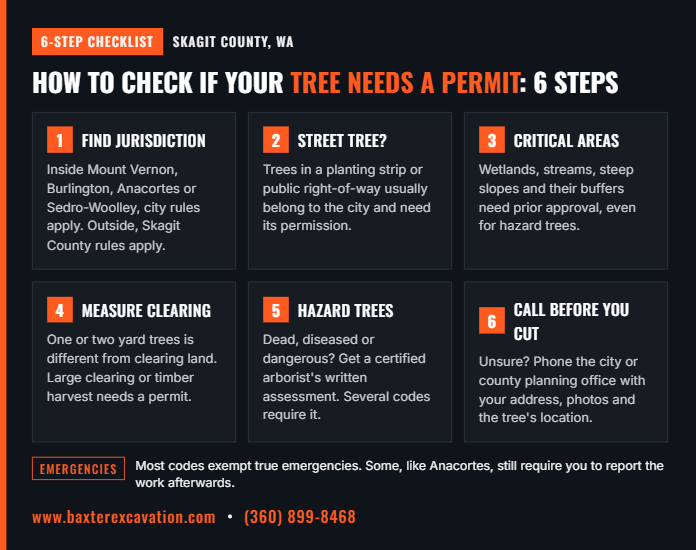
Check four things before cutting: whether you’re inside city limits, whether the tree is a street tree, whether it sits in a critical area, and how much land you’re clearing. If none apply, most Skagit homeowners can remove a single tree without a permit.
- Find your jurisdiction. Check your property tax statement or parcel record. Inside Mount Vernon, Burlington, Anacortes, or Sedro-Woolley, city rules apply. Outside, Skagit County rules apply.
- Check if it’s a street tree. Trees in a planting strip or public right-of-way usually belong to the city. Removing them needs city permission.
- Look for critical areas. Wetlands, streams, steep slopes, and their buffers are protected. Tree removal there needs prior approval, even for hazard trees.
- Measure the clearing. Removing one or two yard trees is different from clearing land. Large clearing or timber harvest needs a permit.
- Document hazard trees. If the tree is dead, diseased, or dangerous, get a certified arborist’s written assessment. Several codes require it.
- Call before you cut. When unsure, phone the city or county planning office. Bring your address, photos and the tree’s location.
Most codes in this guide exempt true emergencies. Some, like Anacortes, still require you to report the work afterwards.
Unincorporated Skagit County tree removal rules
Outside city limits, no permit is needed to cut trees for personal use on less than 2 acres. Approval is needed for hazard trees in critical areas, timber harvests over 5,000 board feet on 2+ acres, and converting forest land to another use.
Personal-use cutting: no permit
Cutting less than 2 acres for personal use needs no permit. Neither does cutting 2+ acres if it’s under 5,000 board feet. (Source: Skagit County PDS — Clearing, Grading and Forest Practices)
Larger harvests: Washington DNR permit
Harvesting over 5,000 board feet on more than 2 acres needs a Forest Practices permit from Washington DNR. (Source: Skagit County PDS)
Skagit County falls under DNR’s Northwest Region: (360) 856-3500, NW_FP@dnr.wa.gov. (Source: WA DNR — Forest Practices)
Clearing land to build: Class IV-G permit
Harvesting timber for a non-forestry use, such as a new home, needs a Class IV-G permit. It’s a joint application with Skagit County and DNR. (Source: Skagit County PDS)
Skipping it can trigger a six-year development moratorium on the land. (Source: Skagit County PDS)
Critical areas: prior approval for hazard trees
Critical areas include wetlands, streams and their buffers, slopes over 30% and flood hazard areas. Owners should submit a Request for Critical Areas Review. (Source: Skagit County PDS)
Hazard trees in these areas need prior written approval from Planning and Development Services, unless it’s an emergency. (Source: SCC 14.24.130)
If the County doesn’t respond within ten business days, the request is approved automatically. (Source: SCC 14.24.130)
Removed trees must be replaced with native species within one calendar year. (Source: SCC 14.24.130)
For hazard trees, a qualified professional means a certified arborist, certified forester or landscape architect. (Source: SCC 14.24.130)
Mount Vernon tree removal permit rules
In Mount Vernon, you can remove trees on a developed private lot without a land clearing permit, and clearing under 2 acres is exempt. Removing or majorly pruning a tree in a planting strip, right-of-way, or other public place needs written permission from the Parks Director.
Street and planting-strip trees: Parks Director permission
No one may do major pruning or remove trees in planting strips, improved rights-of-way or other public places without the Parks Director’s written permission. (Source: MVMC 12.28.060)
“Major pruning” means cutting branches 2 inches or more in diameter, root pruning, or removing over 10% of the foliage. (Source: MVMC 12.28.020)
Owners next to streets not on the city’s maintenance list must maintain the street trees in their planting strip. (Source: MVMC 12.28.060)
Topping is unlawful on city property and discouraged on private property. (Source: MVMC 12.28.060)
Private property: land clearing permit rules
Land clearing needs a permit from the planning director, unless an exemption applies. (Source: MVMC 15.18.030)
These are exempt from the land clearing permit: (Source: MVMC 15.18.050)
- Land clearing of less than 2 acres
- Clearing on developed land that needs no other permit or SEPA review
- Routine gardening on developed lots
- Under 5,000 board feet of timber for personal use in any 12 months
- Emergency removal where there’s immediate danger to life or property
- Dead, diseased or dying trees, with written verification from a qualified arborist, landscape architect or landscape contractor
Permits are handled by the Community and Economic Development Department. (Source: MVMC 15.18.020)
Burlington tree removal permit rules
In Burlington, a permit is required to plant, remove, top or majorly prune a street tree. Apply to the Community Development Department. Trees on private property aren’t covered by the street tree permit, but landscaping rules in the zoning code still apply to development sites.
Street trees: permit required
A permit is required before planting, removing, topping or majorly pruning a street tree. (Source: BMC 12.20.050)
Applications go on city forms with a vicinity map, scaled site plan, and the size and species of trees. (Source: BMC 12.20.050)
The Community Development Department reviews code compliance. Public Works reviews engineering and traffic safety. (Source: BMC 12.20.050)
Removing a street or park tree without a permit brings a fine and a duty to replace the tree. (Source: BMC 12.20.130)
Stumps of street and park trees must be removed below ground level. (Source: BMC 12.20.100)
Private property trees
Tree planting, pruning and removal on private property is governed by the landscaping rules in BMC Chapter 17.81. (Source: BMC 12.20.120)
The City may order removal of dead or diseased private trees that are a hazard to life or property. (Source: BMC 12.20.110)
Owners must keep 13 feet of clearance over streets and 8 feet over sidewalks. (Source: BMC 12.20.090)
Anacortes tree removal permit rules
Anacortes has no general tree removal permit for existing single-family lots in its tree preservation chapter. Approval is required for trees in critical areas and buffers, where even hazard trees need prior written approval and a certified arborist’s risk assessment. New subdivisions need a tree preservation plan.
Critical areas: approval and arborist report
To fell a hazard tree in a critical area or buffer, the landowner must first get written approval from the City, unless it’s an emergency. (Source: AMC 19.70 Critical Areas)
An ISA-certified arborist must submit a tree risk assessment showing a real threat to life or property. (Source: AMC 19.70)
Removed trees must be replaced with native species within one year, under an approved restoration plan. (Source: AMC 19.70)
Removing non-hazard trees in a critical area or buffer needs a critical area permit and report. (Source: AMC 19.70)
Emergency work must be reported to the City within 30 days. (Source: AMC 19.70)
Unauthorized removal can cost $3,000 per non-significant tree and $9,000 per significant tree, plus area penalties. (Source: AMC 19.70)
Subdivisions: tree preservation plan
A tree preservation plan is required when subdividing residential land, including short plats. (Source: AMC 16.50.050)
Anacortes defines a hazard tree as one with unreasonable risk of failure within 1.2 tree lengths of a structure or frequently used outdoor area. (Source: AMC 16.50.030)
Sedro-Woolley tree removal rules
Sedro-Woolley’s tree chapter sets no removal permit for private trees. Instead, owners must remove or fix hazardous and nuisance trees that threaten streets or sidewalks. The Public Works Director makes the final decision on removing a hazardous street tree, and planting in public places needs city permission.
The City updated its street tree rules in Ordinance 2093-24, passed January 8, 2025. (Source: Sedro-Woolley Ordinance 2093-24)
Hazardous or nuisance street trees must be removed or fixed by the property owner. (Source: SWMC 12.40.080)
“The final decision to remove a hazardous or nuisance tree shall be made by the public works director.” (Source: SWMC 12.40.080)
For trees not immediately dangerous, the City may ask for a certified arborist’s report first. (Source: Ordinance 2093-24)
A private tree that overhangs public property and endangers people or property is a public nuisance. Owners get 30 days from notice to trim or remove it. (Source: SWMC 12.40.130)
Stumps must be removed below ground, with roots treated to stop sprouting. (Source: SWMC 12.40.050)
Trees along state highway right-of-way follow WSDOT’s removal and replacement policies. (Source: SWMC 12.40.080)
Trees near power lines and underground utilities
Never cut trees near power lines yourself. Puget Sound Energy trims trees near pole-to-pole lines at no cost. For the service line to your home, PSE provides a free safety disconnection with at least 5 business days’ notice. Before grinding stumps or digging roots, Washington law requires an 811 utility locate.
PSE trims or removes hazardous trees near its distribution lines at no charge. (Source: PSE Tree Trimming FAQs)
For service lines, call PSE at 1-888-321-7779 at least 5 business days before work. (Source: PSE Tree Trimming FAQs)
Washington’s Dig Law, RCW 19.122, requires underground utilities to be located before digging. Give 2 to 10 business days’ notice. (Source: WA UTC — Dig Law)
How Baxter’s Excavation helps with tree removal permits
Baxter Excavation checks permit needs during every free on-site tree removal estimate in Skagit County. We look at city limits, street trees, critical areas, and power lines before work starts, so you don’t face fines, stop-work orders, or surprise replacement costs.
We’re a licensed and insured contractor based in Burlington, WA, serving Mount Vernon, Anacortes, Sedro-Woolley, and all of Skagit County.
Our crew removes the tree, grinds the stump and grades the ground with the equipment we bring to the job. No second contractor needed.
Planning a tree removal? Call (360) 899-8468 or request a free estimate. Learn more about our tree removal services in Skagit County.
Wondering about price? Read our 2026 tree removal cost guide for Skagit County.
Tree removal permit FAQs
Can I cut down a tree on my own property in Skagit County?
Usually yes, for a single tree outside critical areas. Wetlands, stream buffers, steep slopes, city street trees, and larger clearing need approval first.
Do I need a permit to remove a hazard tree in Skagit County?
In critical areas, yes. Skagit County requires prior written approval from Planning and Development Services, except in emergencies, under SCC 14.24.130.
Do I need a permit to remove a tree in Mount Vernon?
Not for most trees on developed private lots. Street and planting-strip trees need the Parks Director’s written permission under MVMC 12.28.060.
Who approves street tree removal in Burlington, WA?
The Community Development Department. A permit is required to plant, remove, top or majorly prune any street tree under BMC 12.20.050.
Do I need a permit to remove a tree in Anacortes?
Not for most trees on existing lots. Trees in critical areas or buffers need City approval and an ISA-certified arborist’s risk assessment.
What happens if I remove a tree without a permit?
Penalties vary by city. Burlington requires replacement trees plus fines. Anacortes fines up to $9,000 per significant tree in critical areas.
Who removes trees touching power lines in Skagit County?
PSE trims trees near pole-to-pole lines free. For service lines to your home, PSE offers a free safety disconnect with 5 business days’ notice.